Crab
Section 1 and most of section 2 are substantially true. Only Malcolm’s name and home have been changed. A steward really did say those exact words to “Malcolm”. Strangers really did help us with the crab attack. Uncut and Louder Than War really did mention the crab. The extracts in section 3 are real. Images are real, but adapted by asking ChatGPT “anonymise this picture by giving all people a new face”.
1. The crab
I first met Malcolm’s crab when I joined him at the End of the Road festival campsite in September 2026. It was definitely red.
He had made it in his cellar in Cawsand over a few weeks that summer: newspaper and paste over a frame, a metre from claw to claw, painted the pillar-box red of a crab in a children’s book. It had two eyes on stalks and was mounted on a salvaged tent pole. Sometimes he would fix a small torch to the pole, uplighting the crab’s underbelly and casting spectacular shadows on ceilings. When he unveiled it beside his tent, I told him it was a crab in the way a child’s drawing of a house is a house: not a real crab, but the idea of one.
End of the Road is an independent music festival held at the end of each summer in Larmer Tree Gardens, Dorset. 2026 was its twentieth year. Fifteen thousand people came.
On the Thursday evening, not long after the crab’s first outing, a steward in a hi-vis tabard walked towards us through the crowd. I saw Malcolm brace himself. He had told me that on the long drive east he’d rehearsed, out loud and more than once, a short defence of the crab, and a fallback plan that involved taking it back to the tent. The steward looked up at the crab, smiled, and said: “It’s fine. As long as you don’t use it as a weapon.” Then the steward walked on.
It was a small moment of the kind End of the Road is known for. Its stewarding is so relaxed that it can be mistaken for hospitality. Malcolm told the story all weekend: in the bar queue, to me, to strangers who stopped to admire the crab. By Sunday I could have told it for him. It was his best festival anecdote, and he never wrote it down. There would have been no point trying to post it anyway. Like many rural festivals, End of the Road is, for practical purposes, offline. Phones there are cameras and torches. Messages queue up and wait.
The crab was a success. People stopped him to say they loved it and asked for photographs. Within hours we found another use for it. With no phone signal, and a crowd in front of every stage, a red crab held a metre above everyone’s heads was something to steer by. It moved, of course, so it was no good as a fixed meeting point, but “look for the crab” usually got you to the right part of the crowd. By Friday, people who had never met Malcolm were using it too.
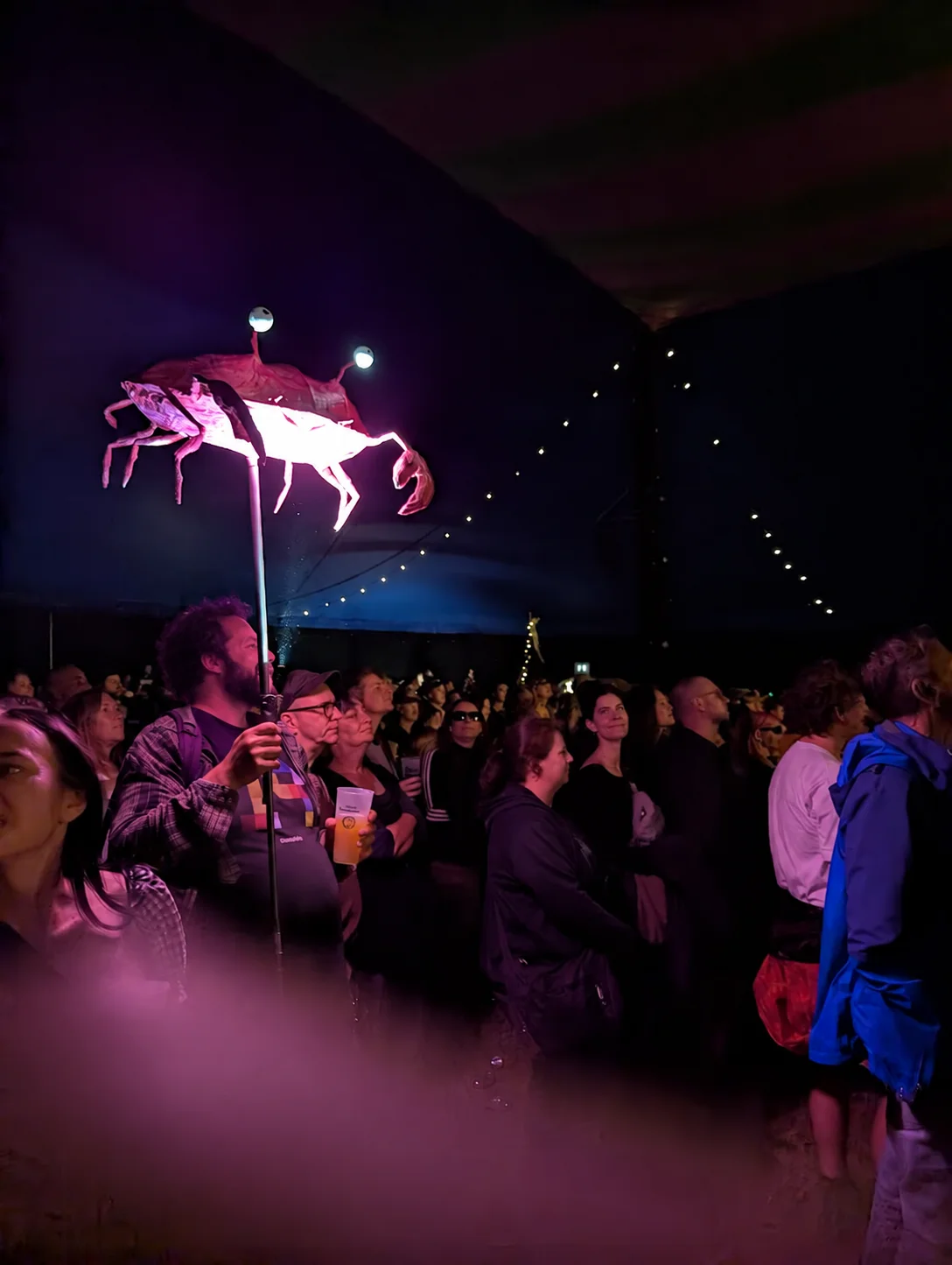
Not everyone was pleased. On Saturday afternoon, between sets, a festival-goer came up to us. The review that later took this person’s evidence calls them only Witness D; I’ll call them Dee. Dee was polite and articulate and had clearly thought the matter through. Dee’s position was that flags in festival crowds are a blight. Anything held up on a pole blocks the view of everyone behind it, and the person holding it is the one person who never has to experience that. The crab, Dee said, was a flag. A funny flag, a well-made flag, but still a flag.
Malcolm listened, then made his case: it was one crab, it wasn’t very big, and people seemed to like it. Dee accepted that the people in front of it liked it. The conversation ended civilly, without agreement. Over the weekend, most people who were asked about the crab landed on the same position, which is also mine: it was brilliant, as long as not everyone did it.
On Saturday night, walking back through the gardens, we came across one of the festival’s installations: a scaffold frame hung with large moveable letters that visitors could rearrange into whatever they liked. Someone had already spelled out a message, not a clean one. Malcolm and a handful of strangers who had stopped to look agreed it could be improved, and between them they took the letters down and rehung them to read CRAB ATTACK. The leftover letters lay scattered on the woodchip. Four of the strangers volunteered to be victims. Malcolm lowered the crab towards them on its pole like a lance, a private nod to the steward, and they recoiled with their hands up and faces frozen in B-movie horror, one of them crouched on the ground. The purple and magenta floodlights made it look like a film poster. Malcolm handed me his phone, and I took the photograph.
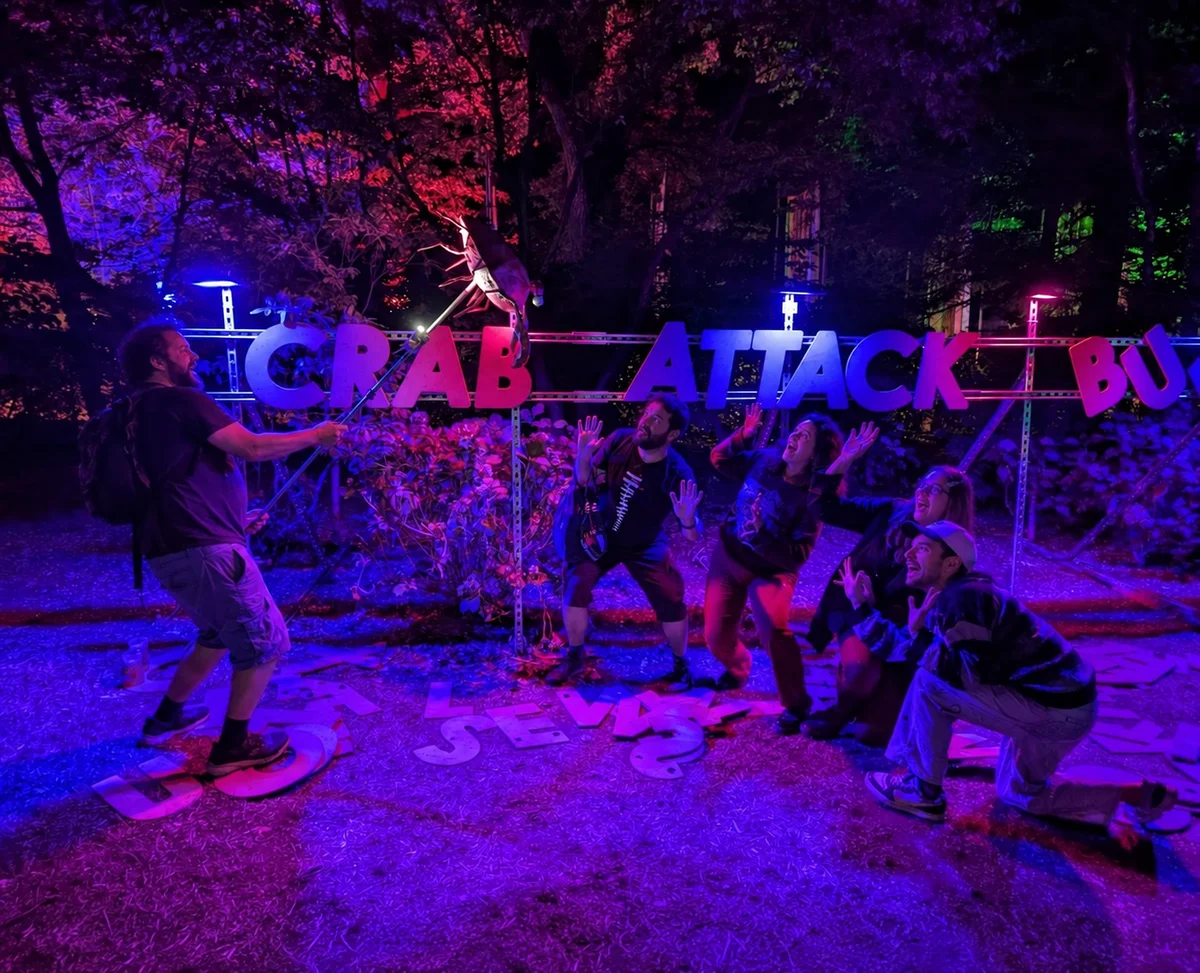
With no signal, the only way to share it was to swap numbers and wait. The four strangers typed their numbers into Malcolm’s phone.
2. Monday
On Monday morning, somewhere on the A354, Malcolm’s phone found a signal and emptied itself. Four days of queued messages went out at once. Among them was the CRAB ATTACK photograph, sent to a new WhatsApp group with the four strangers. They replied with laughing faces and forwarded it to their own family chats, as people do.
WhatsApp compresses images and strips most of the information embedded in them, including where and when a photo was taken. The copies passed between phones that week were smaller and softer than the original and carried no record of where they had come from. Within a fortnight, some had acquired WhatsApp’s small grey label: Forwarded many times.
The original took a different route. It stayed on Malcolm’s phone at full resolution, with the location (Larmer Tree Gardens) and the time still attached. When the phone reconnected, its cloud backup uploaded the weekend’s camera roll and, as these services do, ran it through automatic image recognition so the photos could be searched. Before any person had written a word about the picture, software had described it: A man uses a pole to hold back a large crab-like creature as a group of frightened people take cover beneath a sign reading “CRAB ATTACK”. The tags were crab, attack, fear, emergency, weapon, night.
The festival’s reviews went up that week too. Most were about the music, but the crab had been noticed. Louder Than War counted among the things the festival inspires “papier mache crabs on poles”, in the plural, which was generous. Uncut’s list of weird and wonderful sights included “the giant pink crab on a stick that hovered above the crowd”, which was kind, but pink.
Malcolm read this at his kitchen table. He was delighted to be in Uncut and furious to be pink. He wrote a short, good-humoured post correcting the record. It was the first of many.
Dee went home and wrote a long forum post, carefully argued and properly sourced, under the title Flags, crabs and the tragedy of the sightline. It quoted Uncut. To Malcolm, a crab that hovered over the crowd at nearly every band was a compliment. To Dee, it was the evidence. Most of the replies defended the crab. One man, taking Dee’s side, wrote: Someone needs to take that crab out. He meant, he said later, out of the crowd.
3. Interlude: The Overview
In the week after the festival, people who had seen the crab began searching for it. Google’s AI Overview, the machine-written summary that sits above the search results, told them about it. The following answers were captured that week.
AI Overview
At the End Of The Road Festival 2026, a giant pink crab on a stick became a viral sensation and an unofficial mascot among attendees.
This oversized crustacean totem was spotted hovering over the crowd during almost every major set—including performances by headliners like Pulp and CMAT—making it one of Uncut Magazine’s top “weird and wonderful things spotted” at the festival.
(Note: If you were actually looking for food, the popular street food vendor The Mighty Soft Shell Crab was also part of the official food and drink lineup for the festival.)
Are you trying to track down the owners of the crab totem…
AI Overview
Giant papier-mâché crabs on poles are a whimsical, signature sight spotted around the grounds at the End Of The Road Festival.
• Papier-mâché art: Attendees carry or spot giant handmade crabs and other quirky sculptures raised on poles.
[Video: End of the Road Highlights 2023]
AI Mode · Mon 14 Sep
While exact photos from the festival grounds are kept in the private collections of attendees and the official festival galleries…
These giant, googly-eyed crustaceans are crafted primarily from papier-mâché, wire, and bright paint, mounted high on long wooden poles.
Why Crabs? 🦀
The crabs aren’t tied to any official corporate sponsor or single theme; instead, they represent the festival’s fiercely independent, anti-commercial ethos.
• The “Crab Team”: Volunteers and artists build them ahead of time. During the festival, teams of puppeteers carry them high above the crowds.
• Crowd Navigators: … If you get lost at the main stage, you can just tell your friends to “meet by the giant red crab.”
• Whimsical Energy: The crabs are known to “dance” along to the music, bobbing their claws over the heads of the crowd during upbeat sets, and they have even been known to crowd-surf.
In a week, one crab had become a mascot, then a tradition, then an organisation with volunteers, puppeteers and a philosophy. According to the second answer, it had also been a signature sight since at least 2023, three years before it was made.
4. The Team
It is tempting to blame the machine, and the machine deserves some blame. But the Crab Team was built by many hands, most of them human and most of them meaning well.
The first to pick it up were the websites that exist to be found: content farms, which watch what people are searching for and publish articles to meet the demand. Within days there were explainers titled Who Are The Crab Team? and End of the Road’s Crab Tradition: Everything You Need to Know. As far as anyone can tell, they were written by software from the AI Overview. The Overview was written by software from Uncut and Louder Than War. Uncut and Louder Than War were written by people who had seen one crab.
Then someone, whom the edit history identifies only by an IP address in the south-west, added a sentence to the End of the Road Wikipedia article. It said the festival was known for the Crab Team, a volunteer collective that parades papier-mâché crabs above the crowds, and cited one of the explainers. The article already noted that in 2012 claims had circulated that the festival was secretly run by Scientology. The crabs sat quite naturally alongside.
The next time anyone asked Google about the crab, the Overview cited Wikipedia.
People did the rest. In the festival’s Facebook group, someone asked: Did anyone else see the Crab Team? There were hundreds of replies. YES the crab!! The crab was the best thing all weekend. We used it to find each other. Every one of those people had seen a crab, and every one was telling the truth. Together they confirmed an organisation none of them had seen. One of the four strangers from the photograph, whom the review calls Witness T, replied that he was proud to be a founding member of the Crab Team. He attached the CRAB ATTACK photograph and thought it was a very good joke.
Malcolm did what he could. He posted, patiently and then less patiently, that there was one crab. He had made it, in a cellar, not as part of a collective. He had carried it himself; nobody had puppeteered it. It had never crowd-surfed. And it was red. His corrections didn’t travel as far as the mistake, and when they did travel, they arrived changed. A news aggregator summarised one of them as: A member of the Crab Team has addressed speculation about the crabs’ colour. His denial became evidence that the team existed. Each time he mentioned the colour, “Crab Team colour controversy” climbed a little higher in search results.
Then he made the mistake the review would later describe, drily, as “a notable instance of the subject’s participation in the process”. Buried in Google’s AI Mode answer was the advice to “meet by the giant red crab”. It was the only published source anywhere that agreed with him about the colour. He took a screenshot and posted it with the caption: Even Google says it’s red.
In doing so, he vouched for the one document that had invented everything else.
5. The Bell
By late September the crab had left the internet and reached the pub. On a Friday night at the Bell, on the Dorset–Wiltshire border, three friends sat around a table by the fire.
“Show him,” said Karen.
Mike took out his phone and scrolled. “My sister-in-law sent me this. She got it off someone who was there.”
He held up the CRAB ATTACK photograph, now small and grainy, with Forwarded many times in grey above it. Gaz leaned in.
“That’s staged.”
“Course it’s staged, look at them. But why’s there a sign?”
“It’s an art thing.”
“Right, but it says CRAB ATTACK. Who puts up a sign saying CRAB ATTACK unless there’s been a crab attack?”
“Them,” said Gaz. “They put it up themselves. For the photo.”
That was the closest anyone at the table came to the truth all night, and it was dismissed as boring.
“Then explain this.” Karen had a second photograph. It had been taken on a long lens from the back of the main stage crowd during Pulp’s set and posted to a photo-sharing site, where the photographer had run it through an enhancement filter. The long lens had squashed the depth of the scene, so the crab, much closer to the camera than to the band, sat level with the lighting rig. The pole had disappeared into the dark. The filter, which didn’t know what papier mâché was, had given the crab a glistening shell, jointed legs and, by most counts, two more legs than Malcolm had made.
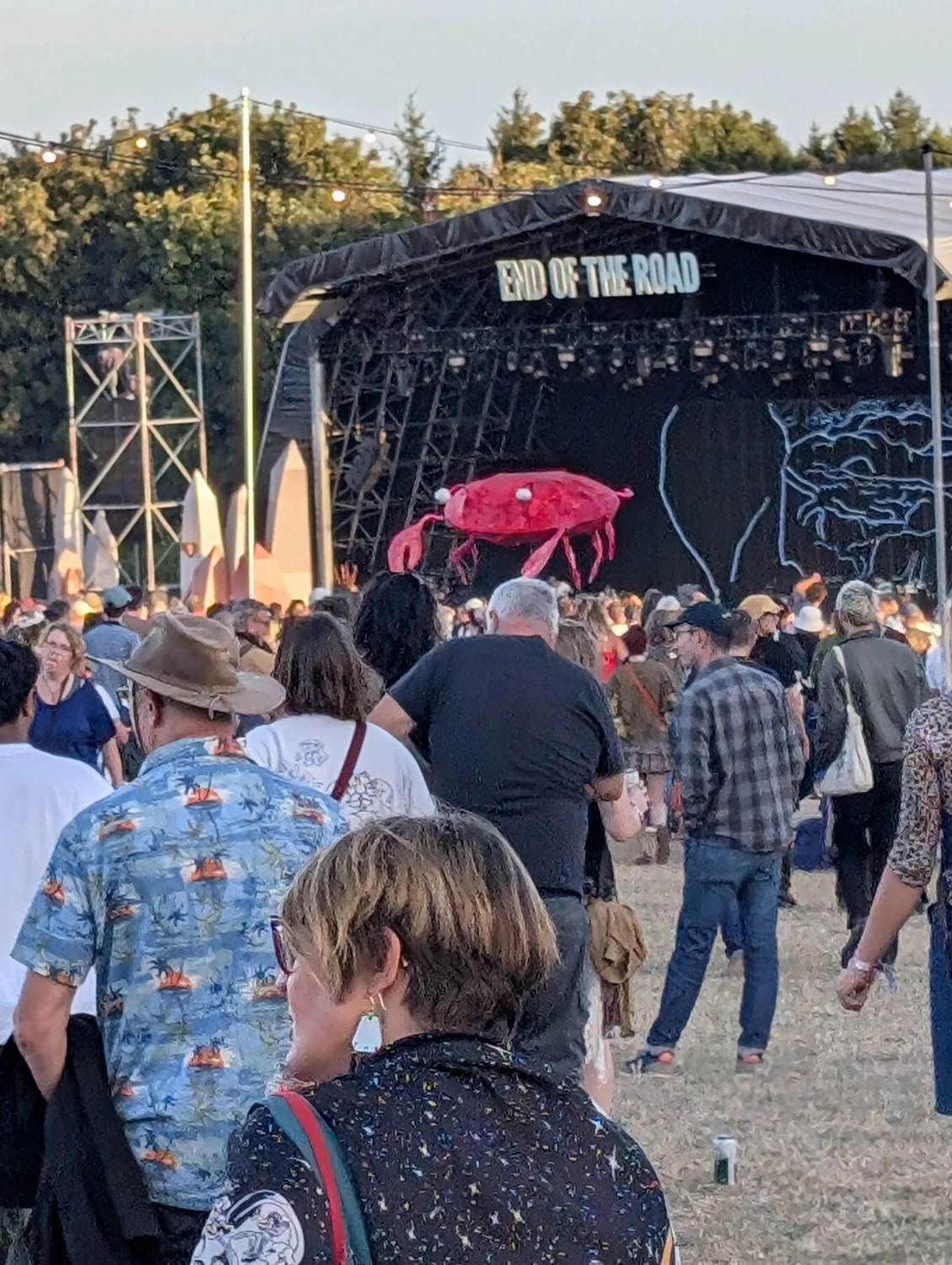
“That’s as big as the stage,” said Mike.
“Someone worked it out,” said Karen. “From how tall the stage is. Fourteen metres.”
“That’s not the same crab as that one,” said Gaz, pointing at the first picture. “That one’s small.”
There was a pause.
“So there’s big ones and little ones,” said Karen.
“Babies,” said Mike.
“You don’t get baby papier mâché.”
“Who says it’s papier mâché? Google says the Crab Team make them. Doesn’t say what they make them out of.”
“It says papier mâché.”
“It also says they’ve been doing it since 2023. There’s a video.”
Nobody at the table had watched the video. There were no crabs in it.
“My mate’s lad went,” said Gaz, who felt he had lost ground. “He said at night you’d hear screaming. In the woods. Every night. Like nothing he’d ever heard.”
“Peacocks,” said the landlord from the other end of the bar. There are peacocks at Larmer Tree Gardens. They wander the grounds, and at night they scream. Nobody paid him any attention.
“And there’s the food stall,” said Karen. “The Mighty Soft Shell Crab. Google brought it up. Separately. Like it was trying to tell you something.”
“Tell you what?”
“Where they go.”
Mike put his phone down. “Porton Down’s just up the road.”
“Everything’s just up the road from Porton Down,” said Gaz, who lived near Salisbury.
“Blandford Camp’s closer,” said the landlord, who was ex-Signals. “And it’s still peacocks.”
By closing time the table had agreed that there had been loads of crabs at the festival, that they came in at least two sizes, that at least one had attacked people, and that Google knew more than it was letting on. When Mike retold the evening in his family WhatsApp group the next morning, the crabs were fourteen metres across and moved between stages on their own.
That last part was true. Malcolm had moved between stages.
6. The hovering
October belonged to video. A TikTok explainer with an AI-generated voiceover, titled The Dorset Carcinisation Event, reached several million views. The name came from the half-serious observation, much loved online, that evolution keeps turning things into crabs. The video put the two photographs side by side, showed the fourteen-metre calculation in red text, and read out Uncut’s line about the crab hovering above the crowd. In the long-lens photo the pole was invisible, so in the video’s version, Uncut had reported the crab floating over the audience.
The video’s creator later said it had been entertainment. The comments did not treat it that way. Every red object in the county became a sighting: a lobster-pot buoy washed up at Studland, an inflatable on Chesil Beach, a pub sign. An AI-generated clip of a crab rising over a field at dusk went round with the caption Dorset, last night.
Someone asked a popular chatbot whether the Dorset crabs could be extraterrestrial. The chatbot replied, carefully and correctly, that there was no confirmed evidence they were. A screenshot of that answer circulated under the headline AI REFUSES TO DENY DORSET CRAB IS ALIEN.
The festival put out a short statement saying there had been one crab, that it belonged to an attendee, and that it was made of papier mâché. The statement ended with a joke. It was widely read as evasive.
Dee’s forum thread, which had gone quiet, came back to life. Dee did not believe in the Crab Team and said so. But several of Dee’s supporters found it easier to argue against a horde than against one man, and repeated the rumour for that reason. It’s not one crab any more, there’s a whole team of them now. Not the least of the story’s ironies is that the Crab Team’s most effective publicists were the people most opposed to it.
7. Interlude: The assessment
Extract from an automatically generated assessment produced on 15 October 2026 by HALYARD, a pilot open-source intelligence fusion system run under a Ministry of Defence hybrid-threat programme from a site in the south-west. Released in redacted form to the Independent Review.
HALYARD // OSINT FUSION // AUTO-ASSESSMENT
REF: SW-2026-1015-0442
CLASSIFICATION: OFFICIAL-SENSITIVE
CONFIDENCE: HIGH (0.87)

SUMMARY
Sustained anomalous activity centred on LARMER TREE GARDENS, in proximity
to BLANDFORD CAMP. Pattern consistent with EITHER (a) presence of
unidentified large objects OR (b) coordinated hostile information
operation. Both hypotheses warrant response.

KEY INDICATORS
1. Communications blackout at site 03-06 SEP (est. 15,000 persons),
   followed by surge of imagery and reporting 07 SEP. Pattern consistent
   with communications interrupted during incident.
2. Geotagged imagery (uploaded 07 SEP, captured 05 SEP) depicts object
   engaging civilians. Machine annotation: "frightened people", "weapon",
   "emergency". Onsite signage: "CRAB ATTACK". Partial ground text
   recovered: "EVAC".
3. Earliest associated sighting: 2023 (source: search summary; video).
   Indicates long-term activity.
4. Named organisation "CRAB TEAM" (source: encyclopaedia; corroborated
   by multiple publications). Self-identified member confirmed (social
   media).
5. Civilian reports of crowd obstruction and distress (forum, 40+ posts).
   Public statements of intent to neutralise object ("take that crab out").
6. Object size estimates 12-15m. Reported hovering (source: national
   music press). Reported autonomous movement between locations.
7. Conflicting statements from organisers regarding object.
   Assessed: possible concealment.

TARGET PROFILE
Large crustacean-form object. Colour: PINK. Est. span 12-15m.
Capable of hovering. Possible juvenile/adult variants.

RECOMMENDED ACTION
Maintain monitoring. On reappearance, deploy autonomous response
element for identification and, if confirmed, neutralisation.
The duty officer approved the recommendation at 16:12. Two days earlier, a junior analyst, identified in the review as Analyst C, had added a note to the file: “Is indicator 1 just because festivals don’t have signal?” The note was marked as read.
8. Maker
The one thing the crab’s maker could no longer put up with was the pink.
By mid-October Malcolm had given up on the Crab Team, which he judged beyond saving, and on the size, which people seemed to enjoy. He would not give up on the colour. Uncut’s line had been joined by the magenta-lit CRAB ATTACK photograph, the only picture in which the crab looked pink and the one everybody used. He decided to settle it. He would take the crab up to Maker Heights, the high ground above Cawsand, at first light on Saturday 17 October, photograph it in daylight beside a professional colour calibration card, and publish the result. He chose the spot for its view across Plymouth Sound and for Maker Church, whose tower has served sailors as a landmark for centuries. The crab had been a landmark, and it seemed right to photograph it beside another one. Nobody mentioned that in the Napoleonic Wars the tower had also been an Admiralty signal station, watching the approaches to Plymouth and reporting what it saw to the fleet. He announced this on Thursday night, with the time and place, so anyone who wanted to could come and watch.
HALYARD read the announcement at 23:08 on Thursday and logged it as a new indicator: Reappearance of object forecast. Location: MAKER HEIGHTS, overlooking approaches to HMNB DEVONPORT. Time: first light, 17 OCT. The proximity of the naval base raised the priority. The recommended action had already been approved.
Saturday came up cold and clear. Malcolm walked up from the road with two friends, a flask, the crab and a grey-and-white card. In the churchyard lane were two dog walkers, a couple from Millbrook, who stopped to ask what he was doing and stayed to see. Across the Sound, the lights of Plymouth were going out. The sun came up over Staddon Heights at about half past seven. Malcolm held the card up next to the crab. The crab was red.
The drones arrived at 07:36. They came in low and fast from the north-east, across the Sound, six dark shapes moving together so exactly that the dog walkers took them at first for a skein of geese. Then the noise reached the heights: not the thin whine of a hobbyist’s quadcopter but a deep, layered thrum that Malcolm felt in his chest before he heard it.
They were nothing like the drones people fly over beaches. Each was the size of a small car, matte grey, with no lights, no logos and no visible cameras, only a smooth sensor housing under the nose that turned as they flew. Slung beneath each one, unmistakably, was something that was not a camera. Nobody on the heights knew enough to name what they were looking at, and nobody needed to.
They did not fly like six machines. They moved like one animal. As they reached the summit they split without any visible signal, fanned out into a wide arc about forty metres from the church tower, and stopped dead in the air, at the same height, facing the same way, stock still despite the gusty wind. Every sensor housing turned towards the crab at once.
Nobody on the heights said anything. The dog barked once, then pressed itself against the woman’s legs. The woman from Millbrook took out her phone, her hands not quite steady, and started filming.
The review’s technical annex records the next nineteen seconds in detail. Each drone pointed its sensors at the object and compared it with the target profile, and the comparison failed on every count. The object was one metre across, not twelve to fifteen. It was on a pole held by a man, not hovering. And under a clear dawn sky, the onboard colour classifier returned, with high confidence: red.
Confidence dropped below the engagement threshold. The formation held for another eleven seconds, as if thinking it over, then turned and flew away north-east, back across the water.
Malcolm lowered the crab. One of his friends had sat down on the grass. The woman from Millbrook stopped filming, checked she had got it, and looked at him.
“Well,” Malcolm said. “At least they’ll know it’s red.”
9. Routine
The video was online by nine. By lunchtime the country knew that the Ministry of Defence had an autonomous drone defence capability it had never announced, because the country had watched that capability line up on a papier-mâché crab.
That afternoon the Ministry described the event as a routine exercise. Within days the AI Overview had updated: In October 2026, a crab belonging to the Crab Team was intercepted by MOD drones during a routine exercise. This was accurate in almost every detail, and it quietly confirmed that the crab had been worth intercepting.
The newspapers did what newspapers did after Orson Welles’s War of the Worlds broadcast in 1938, when they reported a national panic much larger than the one that happened, partly because it gave them a stick to beat a new medium with. The crab was a story about AI, so the panic grew in the retelling to suit. Questions were asked in Parliament about automated targeting, about treating social media as intelligence, and about who exactly had approved it. The Secretary of State announced an independent review. Campaigners against autonomous weapons adopted the crab as a mascot. Someone started selling crabs on poles online. They were pink.
10. Interlude: The review
Extracts from The Independent Review into the Maker Heights Deployment, published March 2027.
3.14 The Review traced the image described at Indicator 2 to a photograph taken on the evening of 5 September 2026. The four individuals shown in it were interviewed. All four stated that they had been pretending to be frightened for the purposes of the photograph.
3.15 The geotagged original from which HALYARD’s annotation was derived was uploaded from the subject’s own phone by an automatic photo backup service. The copies shared with the four individuals by WhatsApp did not contain location data.
3.22 HALYARD derived the text “EVAC” at Indicator 2 from loose letters lying on the ground at the installation. The Review examined the installation. The letters did not spell EVAC.
3.31 The video cited at Indicator 3 as the earliest sighting was reviewed in full. It contains no crabs.
4.07 Witness S, a festival steward, confirmed approaching the subject on the evening of 3 September 2026 and saying words to the effect that the object was acceptable “as long as you don’t use it as a weapon”. The witness characterised the remark as humorous. It was not recorded or published at the time and was therefore not available to HALYARD. The Review notes that it is the only assessment of the object made at the time by a trained member of site staff, and that it was correct.
4.12 Witness D, the author of a forum post cited at Indicator 5, stated that there had only ever been one crab, approximately one metre in span, and that the witness’s objection had concerned sightlines. The Review found Witness D’s account accurate in every respect.
7.2 The Review does not find that any individual acted with malice. It finds that every stage of the process was carried out by a person or system doing what it was designed to do.
Coverage of the review was brief. A widely syndicated news summary reported that a festival steward had warned the crab’s owner against using it as a weapon, and that witnesses said they had been instructed to say they were pretending. The Crab Team section of the Wikipedia article was expanded to include the review, which it cited.
11. Everyone
End of the Road 2027 came round at the end of the summer, as usual. The festival’s website had a new line in its FAQs, meant as a wink to those who knew the story: Crabs on poles are welcome, provided they are not used as weapons. It was scraped within a day, and cited in at least one later article about crab-related safety concerns.
The crabs came in their hundreds. Some were homemade, most bought online. Some were inflatable, a few had lights, one was the size of a small car. There were crabs in solidarity with the campaigners, crabs as a joke, crabs as a tribute, and crabs because everyone else had one. Almost all of them were pink. The Crab Team, which a year earlier had not existed, now did. It had a merchandise stall, a WhatsApp group of four hundred members, and a schism.
The horde was no longer a rumour. A year earlier, when there was only one crab, everyone had agreed it was fine as long as not everyone did it.
Now everyone did, and both of the things that had made the crab good disappeared at once. From the middle of the main stage field you couldn’t see the band at all, just a low, bobbing ceiling of crustaceans. And “look for the crab” meant nothing. People sent each other photos of the crab they were standing under, and every photo looked like every other photo.
On Saturday night Malcolm’s friends couldn’t find him. He was at the back of the field, holding the original crab, the red one. After a while he realised that the person beside him, who also couldn’t see the stage, was Dee.
For a while neither of them said anything. Malcolm looked out at the crabs, then up at his own, and slowly lowered the pole until the crab rested on the grass.
Dee went and bought him a pint.
When Dee came back, someone else came too: a steward in a hi-vis tabard, looking up at the hundreds of poles. The steward recognised the red crab and smiled.
“It’s fine,” said the steward, “as long as nobody uses them as weapons.”
All three of them looked up. Somewhere above the ceiling of crabs, very high up, something was hovering.
Afterword
In the spring of 2028, if you searched Google for Malcolm’s name and the word crab, the AI Overview told you he was a former member of the Crab Team, which he had left in 2026 after a dispute over colour.
This work has shared workings, in line with Kladde 26.
workings ·
fiction index